- Keep tabletop organizer depth under 5 to 6 inches (13 to 15 cm) on surfaces under 20 inches (51 cm) deep.
- Check tabletop thickness—typically 0.5 to 2 inches (1.3 to 5.1 cm)—and rear lip clearance before picking a clamp.
- Use vertical tiers or wall pockets to store 8.5 x 11 inch (21.6 x 27.9 cm) paper upright instead of flat.
Why a Shallow Desk Changes How You Pick a Desk Organizer
Set a standard laptop or an external keyboard on a tabletop under 20 inches (51 cm) deep, and the front-to-back math gets tight right away. Compact writing desks, bedroom alcove tables, and wall-mounted drop-leaf surfaces often measure just 16 to 19 inches (41 to 48 cm) from front to back. A keyboard takes up 5 to 6 inches (13 to 15 cm) of that depth, and resting your wrists in front of the keys uses another 3 to 4 inches (7.6 to 10.2 cm). That leaves roughly 7 to 10 inches (18 to 25 cm) at the back for a monitor base and a desk organizer.
Traditional horizontal paper trays are built around standard US letter sheets measuring 8.5 x 11 inches (21.6 x 27.9 cm). Even with a frame oriented lengthwise or sideways, those trays regularly claim 9 to 12 inches (23 to 30 cm) of front-to-back depth. A tray that deep on a shallow surface pushes your keyboard right to the front lip. Your forearms end up hanging in the air, or the screen sits uncomfortably close to your eyes. Fitting an organizer onto a small or shallow tabletop requires treating front-to-back footprint depth as your first filter, then moving storage upward with vertical tiers, edge clamps, or wall mounts.

Keeping rear storage under 5 inches (13 cm) leaves room for a keyboard and wrists.
Core Measurements for a Shallow-Tabletop Desk Organizer
Grab a tape measure before comparing styles and map out the open strip along the back or side edges of your desk. Total square inches matter less here than how far a unit reaches toward your chair, how high it rises beside your monitor, and how it attaches when lifting storage off the tabletop.
- Footprint depth on the surface: On a desk under 20 inches (51 cm) deep, look for tabletop units using no more than 4 to 6 inches (10.2 to 15.2 cm) from front to back. An upright incline sorter or step file stands 8.5 x 11 inch (21.6 x 27.9 cm) folders on their long 11-inch (27.9 cm) edge or at an upward angle. That upright geometry cuts the footprint depth in half compared to flat stacking trays.
- Vertical stacking height and sightlines: Going tall saves surface area, though the frame height still has to clear your display and any overhead shelving. Positioning the top of a monitor screen near eye level—roughly 15 to 20 inches (38 to 51 cm) above the desktop—can help reduce neck strain. Next to the screen, a 12- to 20-inch (30 to 51 cm) organizer stays tidy without blocking task lamp light or hitting an upper hutch hanging 18 to 24 inches (46 to 61 cm) above the desk.
- Clamp jaw range and throat depth: Clamp-on pegboards and shelves reclaim nearly 100 percent of the surface below them while using only 1 to 2 inches (2.5 to 5.1 cm) of rear edge contact. Most C-clamps fit tabletops 0.5 to 2 inches (1.3 to 5.1 cm) thick. They also require 1.5 to 2.5 inches (3.8 to 6.4 cm) of flat underside clearance with no metal support rails or beveled edges in the way.
- Wall clearance and mounting surface: Pushing a desk against drywall or a partition lets a vertical wall pocket lift files completely off the wood. Measure for at least 12 to 15 inches (30 to 38 cm) of open wall height above the desk surface so bottom folders do not brush against cables or monitor stands.
Measure the underside of your desk edge before choosing a clamp-on organizer. A metal apron frame set just 1 inch (2.5 cm) inward from the back edge can block a standard C-clamp jaw from sliding on.

Measure both tabletop thickness and uninterrupted edge depth before choosing a clamp.
VIVO Black Clamp-on 24 x 20 inch Steel Pegboard Desk Organizer (PP-DK24B)
A desk organizer worth comparing against the criteria in this guide.

See the current price on Amazon.
View on AmazonComparing Shallow-Desk Organizer Configurations
Different mounting and stacking designs trade tabletop space for edge hardware or wall fasteners, and the table below lists examples of typical size ranges across four common organizer styles.
| Organizer Style | Typical Surface Depth Used | Typical Vertical Height | Edge or Wall Requirement | Best For Storing |
|---|---|---|---|---|
| Stepped Wire or Incline Sorter | 5 to 8 inches (13 to 20 cm) | 8 to 12 inches (20 to 30 cm) | None; rests freely on tabletop | Active folders, notebooks, mail |
| Clamp-On Pegboard Panel | 1 to 2 inches (2.5 to 5.1 cm) | 16 to 24 inches (41 to 61 cm) | Flat edge 0.5 to 2 inches (1.3 to 5.1 cm) thick | Tools, headsets, small cups, notes |
| Vertical Wall-Mount File Holder | 0 inches (0 cm) | 14 to 24 inches (36 to 61 cm) | Wall screws, anchors, or partition hangers | Letter-size papers, magazines, clipboards |
| Narrow Multi-Tier Desktop Caddy | 4 to 6 inches (10.2 to 15.2 cm) | 10 to 15 inches (25 to 38 cm) | None; rests freely on tabletop | Pens, sticky notes, chargers, phones |
Start with the second column of the table and compare those depth numbers to the open strip behind your keyboard. A 16-inch (41 cm) deep desk holding a 10-inch (25 cm) laptop leaves only 6 inches (15.2 cm) at the back, so an 8-inch (20 cm) freestanding sorter will overhang the rear edge. That tight gap points instead toward a 1- to 2-inch (2.5 to 5.1 cm) clamp-on panel or a zero-footprint wall holder. Check the fourth column against your furniture structure next, since renters who cannot drill into drywall and owners of desks with thick drawer aprons must rule out wall screws or deep C-clamps.
IKEA SKADIS Pegboard with Desk Connector Clamps fits into this comparison when reviewing specific connector dimensions and compatible accessory details on the product page.
IKEA SKADIS Pegboard with Desk Connector Clamps
One more desk organizer to check against the same criteria.

See the current price on Amazon.
View on AmazonHow Your Choice Changes by Desk Setup and Situation
Placing a freestanding writing desk or a glass-top table out in a room away from a wall rules out wall-mounted pockets immediately. Your options narrow down to a clamp-on upright system or a shallow-footprint tabletop sorter. Solid wood or laminate tops measuring 0.75 to 1.5 inches (1.9 to 3.8 cm) thick with a clear back lip can hold a clamp-on pegboard, turning empty air behind your monitor into vertical storage for cups, cables, and small trays. Tempered glass, lightweight hollow-core board, and perimeter decorative molding cannot handle concentrated clamp pressure or give the jaw a flush seat, so a freestanding stepped wire sorter with a 6- to 8-inch (15 to 20 cm) base depth sits more safely on a corner without stressing the edge.
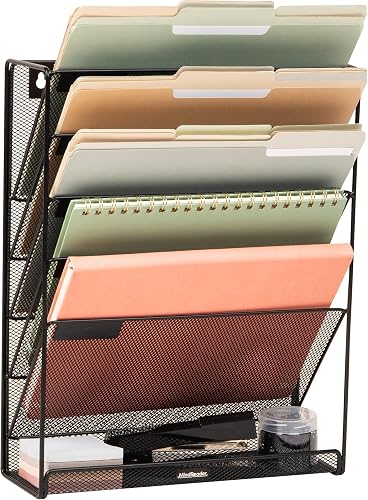
Pushing a desk tight against a wall in a rental apartment or dorm room makes the rear gap behind the furniture the deciding factor. Clamp brackets stick out 0.5 to 1 inch (1.3 to 2.5 cm) behind the back edge and keep the tabletop from sitting flush against the baseboard. Putting two small anchors into drywall—or hanging brackets over a cubicle partition 1.5 to 3 inches (3.8 to 7.6 cm) thick—lets a multi-pocket vertical wall organizer keep the surface 100 percent clear while the desk rests tight against the wall. One option matching this setup is Mind Reader 5-Pocket Vertical Wall File Holder Organizer, provided you verify the mounting hardware and pocket measurements on the product page first.
Mind Reader 5-Pocket Vertical Wall File Holder Organizer
Another desk organizer option to weigh against the points above.
See the current price on Amazon.
View on AmazonKeeping active paper files next to a wide monitor poses a different layout problem than corralling pens and headsets. Standard 8.5 x 11 inch (21.6 x 27.9 cm) manila folders need rigid backing so they do not slump forward into your keyboard zone. If wall mounting is out of the question and clamps cannot clear your desk apron, a vertical step file organizer holds folders in rising tiers. Every tab stays visible while the frame occupies only a narrow strip in the left or right rear corner, and you can compare Fellowes Wire Step File Organizer, 8 Sections (72614) against this layout by checking the exact footprint dimensions and section spacing on the product page.
Fellowes Wire Step File Organizer, 8 Sections (72614)
A desk organizer worth comparing against the criteria in this guide.

See the current price on Amazon.
View on AmazonWhen placing a stepped sorter in the rear corner of an 18-inch (46 cm) deep desk, angle it slightly toward your chair. Angling a 10-inch (25 cm) wide rack by 30 degrees keeps the front corner out of your mouse path while making folder labels easier to read.
Common Questions About Shallow-Desk Organizers
How much clear space should remain in front of a desktop organizer?
Leave at least 10 to 12 inches (25 to 30 cm) of clear depth between the front edge of the desk and the front face of any rear organizer. A full-size keyboard takes up roughly 5 to 6 inches (13 to 15 cm) of depth. Keeping another 4 to 6 inches (10.2 to 15.2 cm) open in front of the keys gives your wrists and forearms a flat resting spot while typing, which can help reduce strain during long sessions.
Can I use a clamp-on desk organizer on a desk with a back modesty panel or metal frame?
A clamp works only if the rear lip overhangs the frame by at least 1.5 to 2 inches (3.8 to 5.1 cm), since most C-clamps need that much horizontal throat depth for the bottom screw pad to sit flat. When a modesty panel meets the back edge flush or a steel tube frame runs 0.5 inches (1.3 cm) inside the perimeter, the clamp jaw hits that barrier early, making a freestanding step sorter or wall-mounted rack the safer choice.
What is the difference between a horizontal tray and a vertical step sorter on a narrow desk?
A horizontal letter tray holds 8.5 x 11 inch (21.6 x 27.9 cm) sheets flat, requiring a frame that spans 9.5 to 12 inches (24 to 30 cm) by 12 to 14 inches (30 to 36 cm) and eats up half the depth of an 18-inch (46 cm) tabletop. By standing those same sheets upright or on a steep incline, a vertical step sorter trims the front-to-back footprint to roughly 5 to 8 inches (13 to 20 cm) while staggering the top edge of each folder within reach.
Research-based. Based on manufacturer specifications and public information. Product details can change after the last-updated date. Prices are not shown here; check the retailer for the current price.