- Aim for a folded thickness under 0.6 inches (15 mm) so the stand slides easily into a laptop sleeve.
- Keep carry weight between 0.5 and 1.2 pounds (225 and 545 g) for daily walking or transit commutes.
- Choose spring-loaded or recessed page holders that lock flush and will not snag fabric linings.
- Balance ultralight portability against base width if you read heavy textbooks on cramped tray tables.
Slide a book stand into a full commuter backpack or slim briefcase, and you quickly spot flaws that never show up on a home desk. Protruding page pegs catch on sweater knits. Wide rear struts or loose hinges press right against a laptop screen, even when the frame looks small when open. Look past open dimensions and check how the hardware folds flat, rides across several city blocks, and fits onto a narrow train tray or coffee shop table.
Why Doesn't Compact Always Mean Packable for a Book Stand?
A folding label does not guarantee an easy fit inside a work bag. Brands usually list the width and height of the front reading board while leaving out the depth of the folded frame. Take a stand with a 10-inch (25 cm) wide board: if its fixed front lip and rear angle bracket stack on top of each other instead of nesting, the collapsed frame can still top 1.5 inches (38 mm) in thickness.
Raw numbers only tell half the story inside a structured bag. Slide a stand into a padded slot next to a tablet or notebook, and any exposed thumbscrews, L-shaped lower ledges, or stiff wire arms become pressure points. Those parts dent leather folios or rub holes through nylon dividers during a 45-minute subway ride, whereas a packable design brings the front tray, page clips, and rear easel into a single flat rectangle.
Before checking open height or angle settings, look at a side-profile photo of the stand completely folded to see if the front ledge folds flat or sticks out at a 90-degree angle.
What Folded Thickness and Footprint Fit Standard Bags?
Start with folded thickness, then check the outer length and width of the closed frame. Standard laptop sleeves in commuter backpacks and briefcases hold 13-inch (33 cm) to 15-inch (38 cm) devices, leaving about 0.8 to 1.2 inches (20 to 30 mm) of extra room once a computer or folder is inside.
Keep the folded thickness at or below 0.6 inches (15 mm) so the zippers close without strain. Thin aluminum or rigid plastic sheet stands compress to 0.3 or 0.4 inches (8 or 10 mm) and slip in like a hardcover notebook. Thicker wood boards or multi-link arms fold to between 0.7 and 1.2 inches (18 and 30 mm); those belong in the main cargo area of a backpack rather than a flat document pocket.
How the stand sits in your bag depends on its outer footprint. A 10-by-7-inch (25 by 18 cm) frame matches a standard tablet or trade paperback and drops easily into a small messenger bag or daypack. Step up to a 12-by-9-inch (30 by 23 cm) board to hold wide textbooks or letter-size folders, and you will need a full-size briefcase or a 20-liter (1,220-cubic-inch) backpack so the corners do not poke the top zipper seam.

Flush hinges and recessed pegs keep folded thickness under 0.6 inches (15 mm).
One option that fits this checklist is Actto BST-09 Green Tea Adjustable Book Stand, and you can compare its listed dimensions against your bag on the product page.
Actto BST-09 Green Tea Adjustable Book Stand
A book stand worth comparing against the criteria in this guide.

See the current price on Amazon.
View on AmazonHow Much Carry Weight and Latch Security Do You Need?
Weight matters when you walk several blocks between transit stops. Still, a frame that is too light can tip backward under a heavy volume or rattle on a moving train table, so pair low carry weight with latches that stay shut in transit and lock open at your seat.
Daily walkers and rail riders usually do well with a stand between 0.5 and 1.0 pounds (225 and 455 g), which weighs about as much as a paperback book or an empty water bottle. Carrying 3-pound (1.36 kg) reference manuals or law textbooks changes the math. An ultralight 0.4-pound (180 g) wire frame can flex or slide as you turn pages, so moving up to a 1.2- to 1.5-pound (545 to 680 g) model with stiffer hinges and a wider base trades a little shoulder load for a steady surface. Raising the book to eye level can help reduce strain on your neck during long study sessions away from home, as long as the stand stays put when the train brakes.
Fast setup at a library desk or airport gate comes down to how the latches work. Hinges and page holders should open in seconds and fold back down without rattling. Check for three hardware details:
- Recessed rear ratchets: Spring-loaded ladders or push-button hinges click into 5 to 7 preset angles between 30 and 60 degrees, then snap flat into the backplate when closed.
- Swivel page clips with detents: Arms rotate 90 or 180 degrees to hold thick margins and use a small notch or magnet to stay flush against the board inside a bag.
- Fold-in front lips: A bottom book ledge measuring 1.2 to 1.8 inches (30 to 46 mm) deep hinges upward against the board after use so it will not hook onto bag pockets.

Quick-latch mechanisms secure moving parts so they do not rattle in transit.
Avoid stands that rely on loose removable pegs or unattached support rods for travel; small pieces easily drop between transit seats or get lost at the bottom of a backpack.
To see how these details come together on a listed model, check the folding layout and build specs for Fellowes Booklift Copyholder (21100) on the product page.
Fellowes Booklift Copyholder (21100)
One more book stand to check against the same criteria.
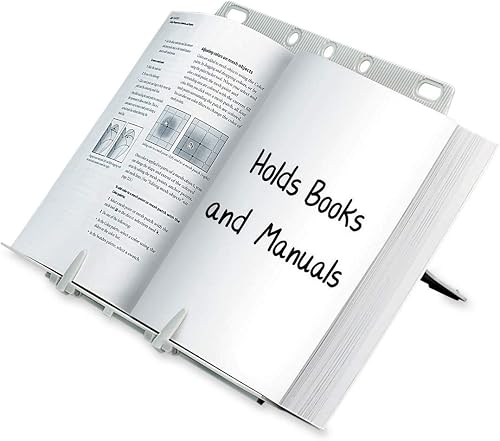
See the current price on Amazon.
View on AmazonComparing Portable Book Stand Profiles for Different Commutes
Your daily route dictates whether pocket-sized lightness, bag fit, or heavy-book stability comes first, and the table below shows example ranges across common portable designs.
| Portable Profile | Typical Folded Thickness | Typical Carry Weight | Typical Folded Footprint | Latch & Hinge Style | Best Commute Scenario |
|---|---|---|---|---|---|
| Ultralight Wire or Sheet | 0.2 to 0.4 inches (5 to 10 mm) | 0.3 to 0.6 pounds (135 to 270 g) | 8 by 6 inches (20 by 15 cm) | Simple friction slots or folding wire bail | Walking commutes, paperbacks, tablets, minimal sling bags |
| Mid-Size Folding Board | 0.5 to 0.7 inches (13 to 18 mm) | 0.7 to 1.1 pounds (315 to 500 g) | 10 by 8 inches (25 by 20 cm) | Recessed ratchet ladder and spring page clips | Subway or bus riders carrying backpacks with trade books or binders |
| Heavy-Duty Collapsible | 0.8 to 1.2 inches (20 to 30 mm) | 1.2 to 1.8 pounds (545 to 815 g) | 12 by 9 inches (30 by 23 cm) | Push-button locking joints and deep folding lip | Car or train travel with thick textbooks and 20-liter (1,220-cubic-inch) bags |
Desk depth scales right along with footprint. Airline and commuter rail tray tables give you only 9 to 10 inches (23 to 25 cm) from the front edge to the seatback. Even a heavy-duty collapsible stand needs an open base depth under 8 inches (20 cm) at a 45-degree reading angle so the rear strut does not hang off the back of a narrow tray.
Kensington InView Copyholder Document and Book Stand (K62051B) is another candidate to measure against these specs on its product page.
Kensington InView Copyholder Document and Book Stand (K62051B)
Another book stand option to weigh against the points above.

See the current price on Amazon.
View on AmazonPre-Purchase Checklist for Bag and Transit Compatibility
Run your bag and books through four quick checks before you pick a model:
- Measure the inside width, height, and spare depth of your laptop sleeve or document divider with a tape measure, then subtract at least 0.5 inches (13 mm) from the width so the frame clears the zipper teeth.
- Check the spine of the thickest book or binder you carry and confirm the front lip opens to at least 1.5 inches (38 mm) for heavy textbooks or 0.8 inches (20 mm) for standard notebooks and paperbacks while still folding flat afterward.
- Zoom in on photos of the folded back and bottom edges to make sure the page-holder tips tuck inside the board perimeter and the rear easel clicks into a channel instead of swinging loose.
- Confirm the front-to-back footprint at a 45-degree angle stays under 7.5 to 8.0 inches (19 to 20 cm) for train tray tables or narrow cafe counters.
If you carry electronics in the same compartment, slip the folded stand into a thin neoprene sleeve or place a file folder between the stand's metal hinges and your laptop lid.
Making the Final Choice for Your Daily Carry
Good travel gear disappears inside your pack and locks tight on the table. Filter first for a folded thickness under 0.6 inches (15 mm), match a weight between 0.5 and 1.2 pounds (225 and 545 g) to the books you carry, and check that every clip and hinge folds flush so nothing scratches your laptop in transit.
Research-based. Based on manufacturer specifications and public information. Product details can change after the last-updated date. Prices are not shown here; check the retailer for the current price.