- Measure your knee height, desk height and weight first; a chair whose ranges miss your numbers cannot be fixed later.
- Seat depth, lumbar support and armrests decide comfort more than the headline features.
- Mesh, foam and leather trade breathability, softness and upkeep differently, so match the material to your room and hours.
Start with your body and your desk, not the chair
Most office chair problems come from a mismatch between the chair and the person, not from a missing feature. A chair that suits someone 5 ft 2 in (157 cm) tall at a standard desk can leave a 6 ft 3 in (191 cm) reader with knees pressed against the underside of the desk. So the first step happens before you open a listing: measure.
Three numbers do most of the work. Sit on a firm chair with your feet flat and thighs roughly level, then measure from the floor to the back of your knee. Measure the floor to the underside of your desktop as well, because that is the clearance your legs and the chair's armrests have to share. Finally, note your weight. Every chair has a rated capacity, and a chair rated close to your weight is a worse bet than one rated well above it.
Keep the numbers next to the listing while you compare. A seat height range that does not include your knee measurement is a dead end, however good the rest of the page looks.

The five places on an office chair where fit is decided.
Support: where an office chair has to hold you up
Support in an office chair comes from three places: the backrest, the seat and the arms. The backrest should reach the curve of your lower back, and the best way to get that is a lumbar support you can move up and down. A fixed bulge that lands two inches too high does more harm than a flat back, because you end up sitting against it in the wrong place.
Seat depth is the adjustment people skip and then regret. With your back against the backrest, you should be able to slide about two to four fingers between the front edge of the seat and the back of your knee. Too deep and the edge presses behind the knee, so you slide forward and lose the backrest. Too shallow and your thighs are left without support. Taller readers usually need more depth, shorter readers less, which is why a sliding seat is worth looking for.
A chair that cannot adjust to you will make you adjust to it, and sitting in a forced position for hours is rarely comfortable.
Armrests are about where your forearms rest while you type. They should let your shoulders drop and your elbows sit near a right angle. Height-adjustable arms are the minimum, and arms that also move inward or pivot help if your desk is narrow or you switch between typing and a mouse. If the arms hit the desk edge and stop the chair from rolling in, they are in the way, and fixed arms cannot be moved out of it.
Adjustments that matter and ones that mostly do not
Listings love long feature lists. The table below sorts the common ones by how much they usually matter for a person who sits at a desk for several hours. It describes the features in general terms, not any specific product.
| Feature | What to look for | How much it matters |
|---|---|---|
| Seat height | A range that covers your knee measurement with your feet flat | Essential |
| Seat depth | A slider, or a depth that suits your leg length | High |
| Lumbar support | Height-adjustable, so it meets your lower back | High |
| Armrests | Height adjustment, plus width or pivot if possible | Medium to high |
| Tilt and lock | Recline with tension control and a lock you can use | Medium |
| Headrest | Nice for leaning back, not needed for upright typing | Low to medium |
| Casters | Type matched to your floor: hard or soft | Medium |
Casters get ignored until the chair scratches a wooden floor or sticks on carpet. If your floor is hard, look for soft-wheel casters or plan on a mat. A chair mat also saves the chair from slowly grinding a path into thin carpet.
Mesh, foam or leather: what the material changes
Material is mostly a trade between breathability, softness and upkeep. Mesh lets air through, which matters in a warm room, and it keeps its shape without a cushion that flattens. The cost is a firmer feel, and a cheap mesh can sag in the middle over time. Foam feels softer on the first day and holds more heat. How it ages depends on the density of the foam, and the listing rarely tells you.
Leather and faux leather look formal and wipe clean, but they can feel warm and the surface can wear at the edges of the seat. None of these is the right answer for everyone. If you sit for long stretches in a warm room, mesh usually earns its place. If the room is cool and you want a softer seat, foam is a reasonable choice.
Matching a chair to how you work
If you want a mesh task chair to compare against the checklist above, one candidate is the Staples Dexley ergonomic mesh task chair. Check the details on the product page before you decide.
Staples Dexley ergonomic mesh task chair
A mesh task chair to compare against the fit and adjustment checks in this guide.
- Style
- Mesh task chair
Worth checkingCheck the weight rating and the seat height range against your measurements.

See the current price on Amazon.
View on AmazonA second candidate to check against the same list is the Marsail ergonomic office chair. The listing is the place to confirm which parts actually adjust.
Marsail ergonomic office chair
A high-back mesh chair that is worth checking for lumbar and armrest adjustment.
- Style
- High-back mesh chair
Worth checkingConfirm which parts adjust and which are fixed before you decide.

See the current price on Amazon.
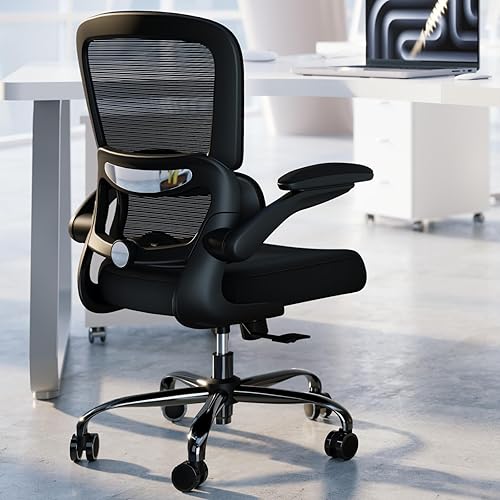
View on AmazonThe TRALT ergonomic mesh desk chair is a third candidate. Look at the seat depth, the lumbar adjustment and the warranty on the product page.
TRALT ergonomic mesh desk chair
A mesh chair listing adjustable lumbar support, one more candidate to check against the checklist.
- Style
- Mesh chair with lumbar adjustment
Worth checkingCheck the seat depth and the warranty on the listing.
See the current price on Amazon.
View on AmazonWhichever you compare, run the same test: do the height range, seat depth, lumbar support and arms cover the numbers you measured? If a listing leaves one of them out, ask the seller or choose another.
Common questions
How do I know if a chair fits before I order it?
Compare the measurements on the listing with the ones you wrote down: seat height range, seat depth, weight rating and overall height under your desk. Check the return policy as well, since a chair is the kind of item you only judge after a few hours of sitting.
Do I need a headrest?
If you recline to read or think, a headrest can be useful. If you sit upright and type, it is often unused, and a chair without one can leave room for a better lumbar support or arms at the same level of quality.
Is a gaming chair the same as an ergonomic chair?
Not by definition. Many gaming chairs use a racing-seat shape with a fixed contour, while task chairs usually put adjustability first. Judge any chair by the adjustment list above, not by the category name on the listing.
Research-based. Based on manufacturer specifications and public information. Product details can change after the last-checked date. Prices are not shown here; check the retailer for the current price.