- Aim for 2 to 3 inches (5 to 8 cm) of clearance between the front seat edge and the back of your knees.
- Look for tall gas cylinders that reach 22 to 24 inches (56 to 61 cm) of seat height for long lower legs.
- Check the width between the armrests, not just the cushion width, and look for 20 to 24 inches (51 to 61 cm).
- Match heavy-duty capacities to ANSI/BIFMA X5.11 standards rated up to 400 pounds (181 kg) or higher.
Why 17 Inches of Seat Depth Leaves Tall Legs Unbalanced
A standard office chair typically stops at 17 inches (43 cm) of seat pan depth and 20 inches (51 cm) of maximum seat height. For someone standing 6 feet 3 inches (191 cm) tall or weighing over 250 pounds (113 kg), those baseline figures quickly turn into daily friction. Knees angle upward above the hips, or thighs hang several inches past the front edge of the cushion. On narrower frames, the inner edges of the armrests press directly into the hips every time you sit down. Getting a proper fit means reading the mechanical spec sheet rather than trusting generic size labels. You need to verify the stroke length of the pneumatic cylinder, the sliding range of the seat pan, the inside-to-inside clearance between armrest pads, and the structural test standard behind the weight rating.
Standard office seating is built around the ANSI/BIFMA X5.1 specification. This benchmark models dimensions and durability around users up to 275 pounds (125 kg) and roughly 5 feet 10 inches (178 cm) in height. Small dimensional mismatches multiply when a user's frame exceeds those baselines. A seat pan that is 2 inches (5 cm) too shallow shifts upper-body weight onto a smaller patch of foam. The cushion then bottoms out faster and leaves the lower thighs unsupported. One model that addresses these dimensional points is Steelcase Leap Plus Office Chair, and you can compare its exact adjustment ranges on the product page against your own measurements.
Steelcase Leap Plus Office Chair
A chair worth comparing against the criteria in this guide.
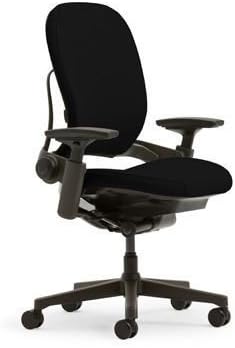
See the current price on Amazon.
View on AmazonCore Sizing Criteria: Depth, Cylinder Stroke, Width, and Capacity
Four tape-measure numbers taken directly from your body will tell you whether a manufacturer's dimensional drawing actually fits. Overall exterior height and width include caster wheels, base prongs, and outer armrest shells, so focus strictly on the usable contact surfaces instead.
Seat Pan Depth and Slider Range
Sit upright against a wall or firm surface to measure horizontally from your tailbone to the crease behind your knee. Subtract 2 to 3 inches (5 to 8 cm) from that number so the front waterfall edge of the cushion clears the soft tissue behind your knees. Standard seat pans measure 16 to 18 inches (41 to 46 cm) deep, whereas taller users with long femurs usually need 19 to 22 inches (48 to 56 cm) of usable depth. A seat depth slider should provide at least 2.5 to 3 inches (6 to 8 cm) of forward-and-back travel. Check whether pushing the seat pan all the way forward opens an uncomfortable gap between the rear of the cushion and the bottom of the backrest.
Pneumatic Cylinder Height and Foot Clearance
Wearing your typical indoor footwear, measure from the floor up to the crease behind your knee while standing or sitting with vertical shins. That measurement equals your target seat-top height, keeping your thighs level with the floor and your knees at a 90-degree to 100-degree angle. Standard pneumatic cylinders adjust between 16 and 20.5 inches (41 and 52 cm) off the floor. Someone over 6 feet 2 inches (188 cm) tall often needs an extended-height cylinder that reaches 22 to 24 inches (56 to 61 cm) at full extension. High-density foam compresses by about 0.5 to 1 inch (1.3 to 2.5 cm) under weight, which makes a listed 21-inch (53 cm) maximum height feel closer to 20 inches (51 cm) once you are seated.

Measure seat depth along the cushion and height from the floor to the top surface.
Measure your existing desk clearance before selecting a tall cylinder: a seat set at 23 inches (58 cm) requires a desktop surface around 30 to 32 inches (76 to 81 cm) high so your thighs fit underneath and your elbows stay near desk level.
Seat Width vs. Inner Armrest Spacing
Spec sheets often list seat cushion width without clarifying usable hip clearance. A chair might feature a 22-inch-wide (56 cm) seat pan while its armrest brackets mount underneath the outer edges, narrowing the actual space between the armrests to 19 inches (48 cm). Soft tissue spreads wider when sitting than when standing, so measure your hip and thigh width while seated and add 1 to 2 inches (2.5 to 5 cm) of clearance. Big-and-tall models generally pair 21 to 24 inches (53 to 61 cm) of cushion width with width-adjustable brackets. Those brackets allow inner armrest spacing to expand from 20 inches (51 cm) up to 25 inches (64 cm).

Inner clearance between the armrests can be narrower than the seat cushion itself.
You can see how these measurements look on a spec sheet by checking HON Wave Big and Tall Executive Mesh Chair (HVL705) and comparing its listed dimensions against your target numbers.
HON Wave Big and Tall Executive Mesh Chair (HVL705)
One more chair to check against the same criteria.

See the current price on Amazon.
View on AmazonWeight Capacity and Heavy-Duty Standards
A listed weight rating is only as reliable as the test standard behind it. Standard task seating follows ANSI/BIFMA X5.1, which tests frames at 275 pounds (125 kg). Larger users should look for ANSI/BIFMA X5.11 compliance, an industry standard engineered for occupants between 253 pounds (115 kg) and 400 pounds (181 kg). Specialty heavy-duty chairs sometimes carry ratings of 450 to 500 pounds (204 to 227 kg). Manufacturers reach those numbers using reinforced steel mechanism plates, wider 27-inch to 28-inch (69 to 71 cm) five-star bases for tip resistance, and Class 4 heavy-duty gas cylinders with thicker steel outer walls. Tilt tension range also matters because a taller, heavier torso puts greater leverage against the backrest during a recline. A heavy-duty coil spring or torsion bar keeps the backrest from dropping backward at the highest tension setting.
Trade-Offs: What You Give Up With Each Sizing Choice
Selecting the largest number in every category creates new fit issues if your build is tall and lean rather than broad, or wide with an average inseam.
- Extended seat depth vs. backrest contact: Sliding a seat pan out to 21 or 22 inches (53 or 56 cm) supports long femurs. On a two-piece seat-and-back design, that extension can open a 2-inch (5 cm) gap behind your hips, letting your pelvis slide backward and lose contact with the lumbar curve.
- Wide armrest spacing vs. shoulder strain: Setting armrests 23 to 25 inches (58 to 64 cm) apart clears wide hips and thighs. For someone with average shoulder width, reaching outward to rest the elbows pulls the upper arms away from the ribcage unless the armrests have inward-pivoting or lateral-sliding pads.
- High-density foam vs. initial softness: Chairs built for 350 to 500 pounds (159 to 227 kg) rely on high-resiliency molded foam or dual-layer spring decks so the seat does not flatten against the base plate after an hour. A lighter tall user, such as someone who stands 6 feet 4 inches (193 cm) and weighs 185 pounds (84 kg), may find that heavy-duty cushion overly firm because they lack the downward mass needed to compress the foam.
- Taller gas cylinders vs. standard desk heights: Raising a seat to 23 inches (58 cm) accommodates long legs, while most fixed-height office desks sit at 29 to 30 inches (74 to 76 cm). Without height-adjustable desk legs or monitor arms, that higher seat forces you to hunch downward toward your keyboard and screen.
If you are tall with a slender build, prioritize a standard-capacity chair that offers an extended seat slider and an optional tall gas cylinder rather than a wide heavy-duty frame whose armrests may sit too far apart for your shoulders.
For an example of how manufacturers balance these specs, check the current configuration options and exact measurements for Steelcase Gesture Office Chair on its product page.
Steelcase Gesture Office Chair
Another chair option to weigh against the points above.

See the current price on Amazon.
View on AmazonComparing Standard, Tall-Configured, and Heavy-Duty Specs
Dimensional ranges shift noticeably across different chair build categories. The table below gives examples of typical figures across standard task seating, tall-configured task seating, and dedicated big-and-tall models.
| Specification | Standard Task Chair | Tall-Configured Task Chair | Big and Tall Heavy-Duty Chair |
|---|---|---|---|
| Rated Weight Capacity | 250 to 275 pounds (113 to 125 kg) | 275 to 300 pounds (125 to 136 kg) | 350 to 500 pounds (159 to 227 kg) |
| Applicable Industry Standard | ANSI/BIFMA X5.1 | ANSI/BIFMA X5.1 | ANSI/BIFMA X5.11 |
| Seat Height Range (Floor to Cushion) | 16 to 20.5 inches (41 to 52 cm) | 17.5 to 23 inches (44 to 58 cm) | 18 to 23.5 inches (46 to 60 cm) |
| Usable Seat Pan Depth | 16 to 18.5 inches (41 to 47 cm) | 18 to 21.5 inches (46 to 55 cm) | 19 to 22 inches (48 to 56 cm) |
| Seat Cushion Width | 19 to 20.5 inches (48 to 52 cm) | 20 to 21 inches (51 to 53 cm) | 22 to 24.5 inches (56 to 62 cm) |
| Inner Armrest Clearance | 17.5 to 19.5 inches (44 to 50 cm) | 18.5 to 21 inches (47 to 53 cm) | 21 to 25 inches (53 to 64 cm) |
| Backrest Height Above Seat | 20 to 23 inches (51 to 58 cm) | 23 to 26 inches (58 to 66 cm) | 24 to 28 inches (61 to 71 cm) |
Another candidate to run through this dimensional comparison is Haworth Fern Office Chair, whose full breakdown is listed on the product page for checking against your body measurements.
Haworth Fern Office Chair
A chair worth comparing against the criteria in this guide.

See the current price on Amazon.
View on AmazonOrder of Decisions and Common Sizing Questions
Checking features in a fixed order helps rule out incompatible frames quickly when you read through spec sheets:
- Filter by structural weight rating and standard first: Add 25 to 50 pounds (11 to 23 kg) of margin above your body weight to account for dynamic downward force when sitting down quickly. Then confirm whether your target range calls for an ANSI/BIFMA X5.1 or X5.11 frame.
- Match lower-leg length to cylinder height: Verify that the maximum seat height sits at least 0.5 inches (1.3 cm) higher than your floor-to-knee-crease measurement to make up for foam compression.
- Verify femur length against seat depth: Subtract 2 to 3 inches (5 to 8 cm) from your buttock-to-knee length. Check that the seat pan or its forward slider range covers that span without leaving an excessive gap at the back.
- Check inner armrest width and pad pivot: Make sure the inside-to-inside armrest distance clears your seated hip width by at least 1 inch (2.5 cm), and look for pads that slide or pivot inward toward your torso.
- Confirm backrest height and lumbar travel: The lumbar support should adjust high enough to meet the small of your back, typically 7 to 11 inches (18 to 28 cm) above the compressed seat, without the upper backrest frame pushing your shoulders forward.
When checking backrest height, beware of fixed integrated headrests if your seated torso is longer than average; a built-in headrest contoured for a 5-foot-10-inch (178 cm) user can hit right between the shoulder blades on a 6-foot-4-inch (193 cm) frame.
Can I Swap a Taller Gas Cylinder Into a Standard Chair?
Many office chairs use a universal 2-inch (5 cm) outer-diameter cylinder column with a standard 1.1-inch (28 mm) tapered cone at the bottom and a 0.69-inch (17.4 mm) top pin. An aftermarket extended cylinder with a 7-inch or 8-inch (18 or 20 cm) stroke often fits physically, though some manufacturers use proprietary lever-actuated pins at the top or custom base tapers. Check whether the manufacturer offers a factory-approved tall cylinder option first, because third-party replacements can change base stability at full extension.
Is a Mesh Seat or a Thick Foam Cushion Better for Heavier Users?
Woven elastomer mesh distributes weight across a suspension frame without trapping body heat, and it avoids foam bottoming out over long workdays. Every mesh seat still relies on a rigid plastic or aluminum perimeter ring to hold the tension. For users with wider thighs or heavier builds, the mesh can sag enough in the center that the hard front and side rails press into the legs. A high-density molded foam pan around 3 to 4 inches (8 to 10 cm) thick gives edge-to-edge support without hard side frames, even if you sit slightly off-center.
How Much Height Do Heavy-Duty Caster Wheels Add?
Swapping standard 2-inch (5 cm) twin-wheel plastic casters for 3-inch (7.6 cm) polyurethane rollerblade-style wheels raises the seat pan by roughly 1 to 1.25 inches (2.5 to 3.2 cm). This swap adds legroom and rolls more smoothly over carpet, provided your chair uses standard 7/16-inch by 7/8-inch (11 mm by 22 mm) grip-ring stems.
Why Does Backrest Recline Tension Matter So Much for Tall Users?
A tall user's upper-body mass sits higher against the backrest, turning the torso into a longer lever arm pushing against the tilt mechanism. Even for a 200-pound (91 kg) user, that extra leverage can overpower a standard tilt spring so the backrest drops backward with very little resistance. A multi-turn tension knob or a weight-activated mechanism with manual boost settings helps the backrest hold your upper body at upright and mid-recline angles.
Research-based. Based on manufacturer specifications and public information. Product details can change after the last-updated date. Prices are not shown here; check the retailer for the current price.