- Measure under-desk apron bars and chair armrest width before placing an under-desk drawer unit.
- Full-extension 3-stage ball-bearing slides expose 100% of drawer depth; 2-stage rollers open about 70%.
- Steel walls maximize interior volume, while wood panels dampen noise when opening and closing.
- On desks 47 inches (120 cm) wide or narrower, place floor cabinets beside the desk instead of underneath.
Why Desk Storage Fails to Fit—and What to Measure First
A new drawer cabinet rolls smoothly across the living room rug, only to catch hard against the steel crossbeam hidden beneath the desktop. Even if you angle it past that beam, your office chair armrests now bump the cabinet doors every time you swivel toward the monitor. Across the top of the desk, a wide document sorter can push a keyboard three inches off-center or block the swing of a monitor arm. Choosing a compact surface tray, a portable caddy, or a multi-drawer floor unit starts with a tape measure and a clear map of your working zones.
Match the organizer to your available clearance before looking at compartments. For under-desk pedestals, measure the vertical gap from the floor to the lowest structural rail under the desk. Next, subtract your chair width (outside armrest to outside armrest) from the horizontal legroom. On desks 47 inches (120 cm) wide or narrower, keep the leg well completely empty and place a tall cabinet beside the desk or use vertical desktop trays instead. Once you know the footprint, pick 3-stage ball-bearing slides for full access to deep drawers, or choose open trays and 2-stage slides for shallow, everyday supplies. Keep frequently used pens and notebooks within a 14- to 18-inch (36 to 46 cm) reach radius so you can grab them without leaning forward, which can help reduce strain during long workdays.
Measure the underside of your desk with a flashlight before ordering a pedestal; a perimeter steel frame or cable management tray often hangs 1.5 to 3 inches (3.8 to 7.6 cm) below the tabletop surface.

Measure from the floor to the lowest crossbeam, not the tabletop surface.
Core Buying Criteria: Clearance, Slide Hardware, and Materials
Under-Desk Frames, Chair Armrests, and Desk Width
Most standard desks stand between 28 and 30 inches (71 and 76 cm) tall, so many buyers assume a 27-inch (69 cm) rolling cabinet will slide right underneath. Standing desks with dual motors and modern trestle tables usually rely on a metal apron or center crossbar for rigidity. If a 1-inch (2.5 cm) desktop rests on a 2-inch (5 cm) steel tube frame, your true vertical clearance drops to 25 or 26 inches (64 or 66 cm). Always measure from the floor to the lowest obstruction, including thumbscrews for monitor clamps and under-mount power strips.
Horizontal width is equally unforgiving because an adult task chair with adjustable armrests typically spans 25 to 27 inches (64 to 69 cm) from outer edge to outer edge. You also need another 3 to 4 inches (7.6 to 10 cm) of breathing room to swivel without scraping your knuckles. A standard 3-drawer mobile pedestal is usually 15 to 16 inches (38 to 41 cm) wide. On a desk 47 inches (120 cm) wide or narrower, subtracting two 2-inch (5 cm) legs and a 15.5-inch (39 cm) cabinet leaves just 27.5 inches (70 cm) of knee space, giving you almost no margin to shift your posture. On a 47-inch (120 cm) or smaller surface, skip under-desk pedestals altogether. Park a taller multi-drawer tower outside the desk frame in an adjacent corner, or move your storage onto the desktop with vertical letter trays or a rotating caddy. Wait until your desk reaches at least 55 to 60 inches (140 to 152 cm) in width before tucking a cabinet into the leg well.
Drawer Slide Mechanics: 2-Stage Roller vs. 3-Stage Ball-Bearing
If your organizer includes enclosed drawers, the slide hardware dictates how much of the interior you can actually reach. Entry-level cabinets and lightweight utility drawers often run on 2-stage nylon roller slides or simple friction tracks, which extend roughly 70% of the drawer's total depth. In a 16-inch (41 cm) deep drawer, the back 4.5 to 5 inches (11 to 13 cm) stay trapped underneath the cabinet top. That layout works fine for long rulers, spare paper reams, or shallow desktop drawers where you can reach inside at an angle. The simple track design also has fewer moving parts to jam.
For deep storage or heavy paper files, look for 3-stage telescoping ball-bearing slides. An intermediate rail bridges the cabinet member and the drawer member, allowing a 3-stage slide to achieve 100% full extension and bring the rear wall completely past the front edge of the cabinet. You can lift out bulky label makers, camera lenses, or hanging folders vertically without tilting them. When comparing specifications, check three hardware details:
- Extension ratio: Confirm whether the specification states three-quarter extension (about 70% to 75%) or 100% full extension, especially on bottom file drawers.
- Load rating per pair: Basic friction or roller tracks typically support 20 to 35 pounds (9 to 16 kg), whereas steel ball-bearing slides are commonly rated for 65 to 100 pounds (29 to 45 kg) to handle dense stacks of paper.
- Anti-tilt interlocks: On tall freestanding pedestals, pulling two heavy full-extension drawers open at once shifts the center of gravity forward; a fifth caster on the bottom drawer face or a single-drawer interlock helps keep the cabinet upright.

Three-stage slides bring the back corners of deep drawers into full view.
Wall Thickness, Interior Volume, and Acoustic Dampening
Material choice changes both the usable interior width of every compartment and the noise level in your room. Cold-rolled steel cabinets and wire mesh desktop trays use thin walls, often 0.02 to 0.04 inches (0.5 to 1.0 mm) thick for sheet steel. In a 15-inch (38 cm) wide steel cabinet, the structural shell and slide gaps take up very little space, leaving about 12.5 to 13 inches (32 to 33 cm) of usable inner drawer width. The trade-off is acoustic resonance. Dropping a metal stapler onto a bare steel tray or pushing a metal drawer shut produces a sharp clatter unless you line the bottom with felt or silicone mats.
Engineered wood (such as MDF or particleboard) and solid wood organizers rely on panels that are typically 0.5 to 0.75 inches (12 to 19 mm) thick. On that same 15-inch (38 cm) outer footprint, two thick side walls plus the drawer box panels can reduce the interior width to 10.5 or 11 inches (27 to 28 cm). What you give up in internal volume, you gain in sound absorption because dense wood fibers naturally dampen vibrations and make wooden drawers noticeably quieter during a video call. Molded ABS plastic and faux-leather caddies sit in the middle with walls at 0.08 to 0.16 inches (2 to 4 mm) thick. They wipe clean with a damp cloth and avoid the metallic ring of wire mesh, though wide plastic trays can flex slightly under heavy books.
The table below compares common organizer configurations; the numbers are examples of typical ranges found across standard home and office furniture.
| Organizer Category | Typical Outer Width | Slide or Access Type | Wall Thickness (Example) | Best Desk Size Match |
|---|---|---|---|---|
| Desktop Tray / Mesh Rack | 9 to 14 in (23 to 36 cm) | Open slots & friction mini-drawer | 0.03 to 0.08 in (0.8 to 2 mm) | Any desk with 12 in (30 cm) corner depth |
| Portable Caddy / Rotating Turntable | 8 to 12 in (20 to 30 cm) | Hinged lid or 360-degree swivel base | 0.08 to 0.20 in (2 to 5 mm) | Shared tables or desks under 47 in (120 cm) |
| Under-Desk Steel Pedestal | 15 to 16 in (38 to 41 cm) | 3-stage ball-bearing (100% extension) | 0.02 to 0.04 in (0.5 to 1 mm) | Desks 55 in (140 cm) wide or wider |
| Under-Desk Wood Pedestal | 15.5 to 18 in (39 to 46 cm) | 2-stage roller (70%) or 3-stage slide | 0.50 to 0.75 in (12 to 19 mm) | Desks 60 in (152 cm) wide or wider |
Standard US letter paper measures 8.5 by 11 inches (21.6 by 27.9 cm), so look for an interior tray width of at least 9.25 inches (23.5 cm) to prevent paper edges from curling against the side walls.
Which Setup Fits Your Workspace?
On a desk 47 inches (120 cm) wide or narrower that already holds a laptop stand and external monitor, floor pedestals under the desk will crowd your legs, making vertical desktop storage the practical route. Look for a tiered rack that stacks letter trays above a shallow sliding drawer. This setup consolidates loose papers, sticky notes, and charging cables into a single footprint roughly the size of one sheet of paper. One option that fits this checklist is Marbrasse Mesh Desk Organizer with 4 Trays and Sliding Drawer, and you can check the exact dimensions and compartment layout on the product page.
Marbrasse Mesh Desk Organizer with 4 Trays and Sliding Drawer
A desk organizer worth comparing against the criteria in this guide.

See the current price on Amazon.
View on AmazonSplitting your week between a dining table, a compact home desk, and a shared office bench means fixed drawers cannot follow you from room to room. A self-contained desktop case with movable internal dividers keeps adapters, styluses, and memory cards in one predictable spot while doubling as a surface pad when opened up.
Orbitkey Nest v2 Portable Desk Organizer
One more desk organizer to check against the same criteria.
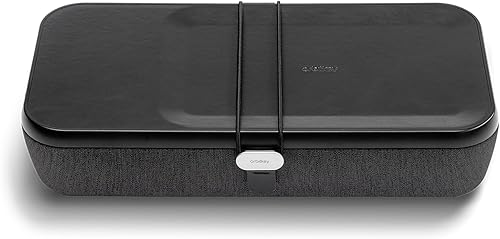
See the current price on Amazon.
View on AmazonStoring tall markers, scissors, glue bottles, or small craft jars in the back corner of an L-shaped desk or inside a deep overhead cubby often causes you to knock items over when reaching past the front row. A turntable organizer that spins 360 degrees on stainless steel ball bearings brings rear compartments to the front with a flick of the wrist. It also removes the need for drawer pull-out clearance in tight corners. mDesign Plastic Craft and Office Rotating Lazy Susan Turntable Storage Organizer is a reasonable candidate to run through the points above, provided you confirm the diameter and divider heights on the product page before deciding.
mDesign Plastic Craft and Office Rotating Lazy Susan Turntable Storage Organizer
Another desk organizer option to weigh against the points above.

See the current price on Amazon.
View on AmazonCommon Questions
How Much Space Should I Leave in Front of a Drawer Organizer?
For a desktop tray with a pull-out drawer, leave at least 8 to 10 inches (20 to 25 cm) of clear desk surface directly in front of the unit so the open drawer does not hit your keyboard or mouse mat. For a floor-standing cabinet with 100% full-extension slides, add the cabinet depth to the full drawer length plus standing room. An 18-inch (46 cm) deep cabinet needs another 18 inches (46 cm) for the open drawer and at least 16 inches (41 cm) for you to kneel or stand beside it, totaling about 52 inches (132 cm) of front-to-back floor depth.
Before peeling the backing off adhesive felt pads, place your empty desktop organizer on the desk and swing your monitor arm through its full range to make sure the lower bezel clears the top tray.
Should I Choose Swivel Casters or Fixed Leveling Glides for a Floor Cabinet?
Swivel casters add 2 to 2.5 inches (5 to 6.4 cm) to the overall height of a cabinet, which can mean the difference between clearing an under-desk crossbar and getting stuck. Choose casters if you vacuum under the cabinet weekly or plan to roll the unit beside your chair as an extra work surface. Be sure to verify that the front two wheels have locking levers so the cabinet stays put when you pull a sticky drawer. Choose low-profile leveling glides when your vertical clearance is tight or your floor is uneven, since threaded glides let you dial out a 0.25- to 0.5-inch (6 to 13 mm) wobble on hard flooring or across the edge of a thick area rug.
Research-based. Based on manufacturer specifications and public information. Product details can change after the last-updated date. Prices are not shown here; check the retailer for the current price.