- Pick 14 AWG or 12 AWG cords for high-draw appliances rather than light 16 AWG cords.
- Keep continuous loads within 80 percent of a standard 15 A, 120 V circuit, or 1,440 W.
- Match overload breakers to dry indoor desks and ground-fault protection to damp utility areas.
- Check UL 1363 and UL 1449 markings along with outlet spacing for bulky power bricks.
Matching a Power Strip to Your Appliances and Room
Plug a desktop computer, two monitors, and a laser printer into one wall corner, and a basic cord can quickly warm up. Running a microwave alongside a countertop toaster oven in a kitchenette can also trip a breaker. Choosing the right power strip comes down to three core specifications that match US household wiring. You need to check the copper wire thickness in American Wire Gauge (AWG), the continuous wattage margin on a 120 V circuit, and whether the breaker trips for overloads alone or also for moisture-related ground faults.
Most wall receptacles in a standard US home sit on 15 A, 120 V branch circuits rated for 1,800 W on paper. Electrical codes and appliance standards require a 20 percent buffer for continuous loads that run for 3 hours or more. That buffer puts your real working ceiling on a 15 A power strip at 1,440 W. A standard 16 AWG cord handles lamps, phone chargers, and a laptop comfortably, while high-draw gear in a garage, laundry area, or workshop calls for a thicker 14 AWG or 12 AWG cord with the right circuit breaker.
Check the jacket stamp embossed along the cord itself, such as SJT 14 AWG, rather than relying only on the total wattage printed on the front of the box.
Comparing Wire Gauge, Load Capacity, and Protection Types
The copper conductors inside a power strip cord determine how much current can flow without generating excess heat. Under the American Wire Gauge system, a smaller number indicates a thicker copper cross-section. A typical light-duty strip uses 16 AWG wire (about 1.31 sq mm), which is rated for up to 13 A, or 1,560 W peak at 120 V. Medium-duty and heavy-duty household strips use 14 AWG wire (about 2.08 sq mm) rated for a full 15 A (1,800 W). Workshop or commercial strips built for 20 A circuits step up to 12 AWG wire (about 3.31 sq mm) rated for 2,400 W at 120 V. Cord jackets also carry letter codes: SPT-2 or SVT appears on lighter residential cords, whereas SJT or SJTW indicates a thicker thermoplastic jacket built to resist desk chairs, foot traffic, and hard floors.

Lower AWG numbers mean thicker copper cores that handle higher continuous wattage.
Running a power strip near its stamped 15 A and 1,800 W upper bound for hours warms both the plug blades and the internal bus bars, because paper ratings and working capacity differ. Applying the widely accepted 80 percent rule for continuous loads lowers the target on a 15 A strip from 1,800 W to 1,440 W. On a 13 A strip, that continuous target drops from 1,560 W to 1,248 W. Plugging an 1,100 W microwave and an 800 W coffee maker into the same strip creates a combined 1,900 W draw, which exceeds the 1,800 W peak rating and trips a 15 A overload breaker or overheats an unprotected cord.
Protection mechanisms also divide into distinct categories based on environment and equipment. Standard relocation power taps follow the UL 1363 standard, while models that include surge suppression components follow UL 1449. Surge ratings are commonly expressed in joules (such as 1,000 J to 4,000 J) and clamping voltage (such as 330 V, 400 V, or 500 V), and strips also differ in their cutoff switches:
- Thermal or magnetic overload circuit breaker: Trips when total current draw exceeds 15 A (or 20 A on heavy-duty models). This design fits dry bedrooms, living rooms, and home offices where nuisance tripping from minor electrical noise is unwanted.
- Ground-Fault Circuit Interrupter (GFCI) protection: Monitors the balance of current between the hot and neutral lines and cuts power within milliseconds if it detects a leak as small as 4 mA to 6 mA from water or damp air. This mechanism is built for laundry rooms, basements, garages, and utility sinks.
- Surge suppression with auto-shutoff: Uses internal Metal Oxide Varistors (MOVs) to divert brief voltage spikes to ground and disconnects power once those components wear out.
The table below outlines how cord specifications and protection setups align across common household tiers; all figures shown are examples of typical ranges found on standard 120 V equipment.
| Specification Tier | Wire Gauge (Cross-Section) | Peak Rating at 120 V | 80% Continuous Target | Typical Jacket & Breaker Type |
|---|---|---|---|---|
| Light Duty (Desk & Charging) | 16 AWG (1.31 sq mm) | 13 A / 1,560 W | 1,248 W | SPT-2 or SJT; basic 13 A thermal breaker |
| Standard Heavy Duty (Home & Office) | 14 AWG (2.08 sq mm) | 15 A / 1,800 W | 1,440 W | SJT or SJTW; 15 A overload breaker + UL 1449 surge |
| Utility & Damp Location | 14 AWG or 12 AWG (2.08–3.31 sq mm) | 15 A–20 A / 1,800–2,400 W | 1,440 W–1,920 W | SJTW; GFCI module (4–6 mA trip) + overload breaker |
Physical layout matters alongside electrical ratings because standard outlets sit about 1.5 inches (3.8 cm) apart from center to center, leaving little room for wide low-voltage transformer bricks. Strips designed for workstations often space two or three receptacles 2 inches to 2.25 inches (5.1 cm to 5.7 cm) apart or orient the slots perpendicular to the bar. Cord length affects placement as well: a 3-foot (0.9 m) cord reduces clutter behind a mounted television, while a 6-foot (1.8 m) or 8-foot (2.4 m) cord reaches a floor outlet from a standing desk without pulling taut.
One option that fits this checklist is Belkin 12-Outlet Pivot-Plug Surge Protector BP112230-08, which pairs these cord and outlet spacing standards in a single housing.
Belkin 12-Outlet Pivot-Plug Surge Protector BP112230-08
A power strip worth comparing against the criteria in this guide.

See the current price on Amazon.
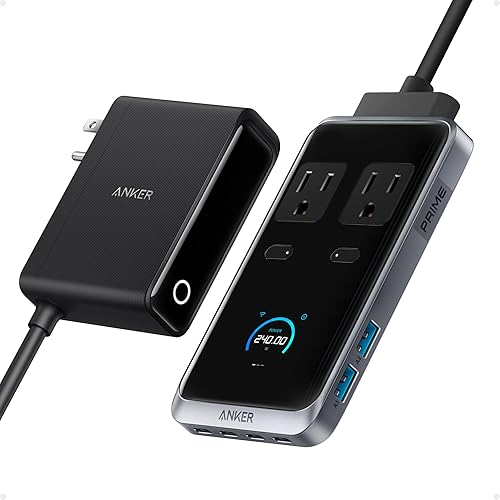
View on AmazonTo see how these criteria apply to another model, Anker 341 USB Power Strip (A9182) offers a point of comparison for port layout and amperage ratings.
Anker 341 USB Power Strip (A9182)
One more power strip to check against the same criteria.
See the current price on Amazon.
View on AmazonWhich Setup Fits Your Space and Equipment
A home office desk or entertainment console in a dry indoor room benefits from an overload circuit breaker paired with UL 1449 surge suppression and wide-spaced outlets. A desktop PC, two 27-inch (68.6 cm) monitors, a router, and powered speakers typically draw between 300 W and 600 W in total. That load stays well below the 1,440 W continuous threshold of a 14 AWG, 15 A strip. In a dry room, a standard 15 A magnetic or thermal breaker prevents overloads without the false trips that sensitive ground-fault sensors can sometimes experience around switching power supplies. Belkin 8-Outlet Home/Office Surge Protector BE108200-06 is a reasonable candidate to evaluate against these cord length and outlet configuration points.
Belkin 8-Outlet Home/Office Surge Protector BE108200-06
Another power strip option to weigh against the points above.

See the current price on Amazon.
View on AmazonHumidity, concrete floors, and occasional splashes in a laundry room, basement workbench, or garage call for a 14 AWG or 12 AWG strip equipped with GFCI protection. Plugging a heavy-duty SJTW-corded strip directly into an existing wall GFCI outlet works as well. Ironing boards, utility vacuums, and battery chargers operating in damp zones need a circuit that cuts off when a 4 mA to 6 mA current leak occurs, since a basic overload switch only reacts above 15 A. Mounting the strip at least 18 inches (45.7 cm) high on a wall or workbench leg keeps slots clear of puddles and sawdust.

Applying an 80 percent continuous load margin keeps a 1,800 W strip within 1,440 W.
Shared kitchen counters, dorm corners, and craft areas where heating appliances or motors cycle on and off require attention to the 1,440 W continuous budget and a 14 AWG SJT cord. A single hair dryer, space heater, or electric kettle often pulls 1,200 W to 1,500 W on its own, leaving almost no headroom on a 15 A circuit for a second heating appliance. High-draw heaters and major appliances belong directly in a wall receptacle whenever possible.
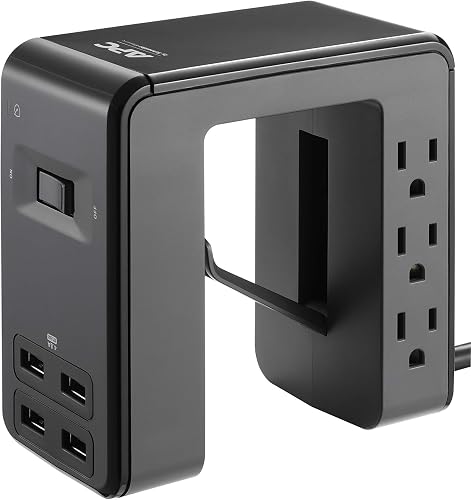
APC SurgeArrest PE76W 7-Outlet Surge Protector
A power strip worth comparing against the criteria in this guide.
See the current price on Amazon.
View on AmazonTo convert an appliance rating from amps to watts on a standard US circuit, multiply the amperage by 120 V; as an example, a 12 A vacuum draws 1,440 W.
Common Questions
Can I plug one power strip into another to reach a distant outlet?
Electrical codes and UL standards advise against connecting two power strips in series, a practice often called daisy-chaining. Plugging one strip into another increases resistance at the plug connections and makes it easy to exceed the 15 A (1,800 W) capacity of the upstream cord and wall receptacle without noticing. When a 3-foot (0.9 m) cord falls short of your wall outlet, a single power strip built with a longer 6-foot (1.8 m), 8-foot (2.4 m), or 10-foot (3.0 m) 14 AWG cord is the safer alternative.
Why does my power strip switch trip even when the total wattage seems below 1,800 W?
Unexpected trips below the 1,800 W mark usually come down to startup surges or lower breaker ratings. Appliances with motors or compressors, such as compact refrigerators, laser printers with fuser rollers, or shop vacuums, draw a brief inrush current that can reach two to three times their running wattage for a fraction of a second and push a 15 A breaker past its threshold. Some strips also pair a 16 AWG cord with a 13 A breaker, which caps peak load at 1,560 W and continuous load around 1,248 W, so checking whether the breaker button is stamped with 13 A or 15 A and moving motor-driven gear to a separate wall circuit typically solves the problem.
If a laser printer causes your desk lights to flicker or trips a shared strip during warm-up, plug the printer directly into the wall outlet and keep monitors and computers on the surge strip.
Research-based. Based on manufacturer specifications and public information. Product details can change after the last-updated date. Prices are not shown here; check the retailer for the current price.