- Check that minimum seat height drops to 16.5 to 17.5 inches (42 to 44 cm) for standard desks.
- Leave a gap of 1 to 2 inches (2.5 to 5 cm), or two to three fingers, behind your knees.
- Compare breathable mesh frames against weight-distributing foam cushions for long sitting hours.
- Verify that armrests drop below a 28 to 30 inch (71 to 76 cm) desk surface to prevent raised shoulders.
Why a Chair That Looks Comfortable Can Still Leave Your Feet Dangling
Sit at a standard fixed-height desk for an afternoon and physical mismatches usually appear at your feet or shoulders. Most desks in the United States stand 28 to 30 inches (71 to 76 cm) tall. A common fixed height is 29 inches (74 cm). Raising a chair to match the keyboard often lifts your heels off the floor. Lowering the chair to plant your feet can cause wrists to bend upward. Armrests may also hit the tabletop edge, keeping you six inches from the keyboard.
Verify four physical measurements in order: minimum seat height, front-to-back seat pan depth, seat cushion construction, and armrest adjustments. First, check that the seat pan lowers to at least 16.5 or 17.5 inches (42 to 44 cm) from the floor. This supports your feet under a standard desk. Second, look for a seat depth that leaves a gap of 1 to 2 inches (2.5 to 5 cm) behind your knees. This is roughly the width of two or three fingers. Third, choose between the airflow of tensioned mesh and the even weight distribution of padded foam. Fourth, confirm that armrests drop low enough to slide under the desk or move backward to keep shoulders relaxed.
Measure the distance from the floor to the underside of your desk apron before checking chair specifications. That single clearance number tells you the maximum armrest height that will slide under your workspace.
Core Buying Criteria: Dimensions, Materials, and Adjustments Compared
Minimum Seat Height and Standard Desk Clearance
Many task chairs advertise a wide pneumatic cylinder range. The bottom number of that range matters most for daily desk work. A typical cylinder moves the seat pan between 17 and 21 inches (43 and 53 cm) off the floor. A chair starting at 19 inches (48 cm) forces a trade-off at a 29 inch (74 cm) desk. Your thighs may angle downward, creating pressure behind the knees. You might also need a separate footrest to stabilize your lower body. A lowest seat height of 16.5 to 17.5 inches (42 to 44 cm) lets most users keep their feet flat. This maintains an open angle of roughly 90 to 100 degrees at the hips and knees.
Seat Pan Depth and Knee Clearance
Seat depth is the distance from the backrest to the front edge of the cushion. Fixed seat pans typically measure 17 to 19 inches (43 to 48 cm) deep. A pan that is too deep presses against the soft area behind your knees. This prevents your lower back from touching the backrest and often leads to slouching. If the pan is too shallow, the front third of your thighs hangs unsupported. This shifts extra load onto your sit bones. A proper fit leaves 1 to 2 inches (2.5 to 5 cm) of space behind the knee. Sliding seat pans typically offer 2 to 3 inches (5 to 7.6 cm) of travel to help different users find this clearance.
Mesh Seats vs. Molded Foam Cushions
Backrests often use mesh, but the material under your hips behaves differently depending on its construction. A suspended mesh seat stretches yarn across a rigid outer frame. Air circulates freely underneath to reduce heat and moisture buildup. Mesh lacks a solid base directly under the center. Shifting weight onto one hip can cause the material to deflect deeply. This may let the hard outer frame press against the undersides of your thighs. Molded foam cushions sit on a solid pan and spread pressure across a wider surface area. Foam can retain more heat and may compress over time if the density is low.
Armrest Height, Width, and Desk Fit
Fixed loop armrests often cause shoulder tension at computer workstations. If armrests sit too high, they push your forearms up and hike your shoulders toward your ears. If the armrests hit the front edge of the desk, you may lean forward away from the backrest to reach your mouse. Height-adjustable arms usually travel 3 to 4 inches (7.6 to 10 cm) vertically. This typically places the pads 7 to 11 inches (18 to 28 cm) above the seat pan. Pads that slide backward or pivot inward let you stay close to the desk edge while supporting your elbows at a 90 degree angle.
If your desk has a center drawer beneath the tabletop, measure from the floor to the bottom of that drawer. Standard under-desk knee clearance drops from around 27.5 inches (70 cm) to 24 or 25 inches (61 or 63.5 cm) when a drawer is present.
The numbers in the table below are examples of typical ranges used to evaluate desk chairs across these four criteria.
| Criterion | Example Target Range | What Happens When It Misses |
|---|---|---|
| Minimum Seat Height | 16.5 to 17.5 inches (42 to 44 cm) | Heels lift off the floor or thighs take excess pressure at a 28 to 30 inch (71 to 76 cm) desk |
| Seat Pan Depth | 15.5 to 18.5 inches (39 to 47 cm) with a 1 to 2 inch (2.5 to 5 cm) knee gap | Front edge presses into the backs of knees or leaves thighs unsupported |
| Seat Material | Tensioned mesh or high-density foam (2 to 3 inches (5 to 7.6 cm) thick) | Mesh perimeter frame touches thighs under uneven load; foam traps body heat |
| Armrest Height Range | 7 to 11 inches (18 to 28 cm) above the seat pan | Shoulders hike upward during typing or arms collide with the front edge of the desk |
Key inspection points to run through when reading a specification sheet:
- Confirm whether seat height is measured to the top of the center cushion or the side bolster. Domed cushions can add 0.5 to 1 inch (1.3 to 2.5 cm) before they compress.
- Check whether seat depth is fixed or includes a sliding mechanism with locking stops every 0.25 to 0.5 inches (0.6 to 1.3 cm).
- Look at the front rim of a mesh seat in profile photos to see if a foam insert pads the rigid front edge.
- Verify whether armrests adjust only in height (1D) or also slide front-to-back, shift side-to-side, and pivot (3D or 4D).
One option that fits this checklist is Steelcase Leap Fabric Office Chair. Check the details and exact measurements on the product page.
Steelcase Leap Fabric Office Chair
A chair worth comparing against the criteria in this guide.

See the current price on Amazon.
View on AmazonWhich Setup Matches Your Workspace and Sitting Habits
Prioritize a chair with a sliding seat pan if you share a workstation. Look for a cylinder that drops to 16.5 inches (42 cm) or lower to accommodate different heights. A fixed 18.5 inch (47 cm) seat depth may fit someone with longer legs. A shorter user in the same chair will likely lose lumbar contact or feel pressure behind the knees. Having 2 to 3 inches (5 to 7.6 cm) of seat slide adjustment lets multiple people use the same desk without adding footstools. If you want to test these criteria on a real product, Steelcase Series 1 Work Office Chair is one to look at. Review the full specifications on the product page.
Steelcase Series 1 Work Office Chair
One more chair to check against the same criteria.

See the current price on Amazon.
View on AmazonPay attention to seat pan ventilation if you work in warm rooms or sit for three to four hours at a time. A suspended mesh seat keeps air moving across your lower body. This reduces sweat buildup compared to a thick block of upholstered foam. This setup works well if you sit squarely in the center of the pan with both feet on the floor. A contoured foam cushion over a flat base plate distributes weight more evenly if you lean sideways or tuck one leg under the other. This design avoids a rigid outer rim around your thighs.
Armrest clearance is the deciding factor in compact workspaces with shallow desks. You need the chair to tuck directly up to the desk edge so your forearms rest comfortably. This prevents you from raising your shoulders to reach the surface. Look for armrests whose lowest setting sits at least 0.5 inches (1.3 cm) below the underside of your desk apron. You can also find arm pads that slide rearward so the front of the pad clears the tabletop. Ticova Ergonomic Office Chair is a reasonable candidate to run through the points above. Take a look at the product page to confirm the dimensions for your setup.
Ticova Ergonomic Office Chair
Another chair option to weigh against the points above.
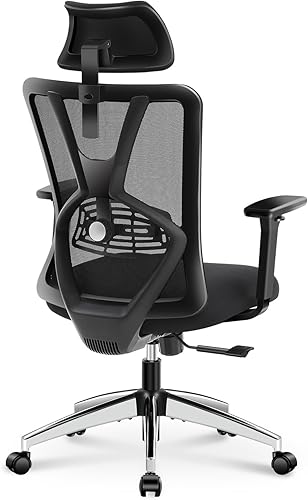
See the current price on Amazon.
View on AmazonTo check your own required seat depth at home, sit against a flat wall on a hard chair, place a book behind your calf, and measure from the wall to the book, then subtract 1.5 inches (3.8 cm).
Common Questions
What if my chair must go higher to match a tall desk, leaving my feet off the floor?
Set the chair height for your upper body first if you cannot lower the work surface. Raise the seat until your elbows bend at roughly 90 to 100 degrees. Keep your wrists level with the keyboard to reduce strain on your neck and shoulders. Measure the gap between your heels and the floor, which is commonly 2 to 4 inches (5 to 10 cm). Place a solid footrest of that height under the desk. Alternatively, install an under-desk keyboard tray to drop the typing surface by 2 to 3 inches (5 to 7.6 cm).
How much backrest recline and lumbar range do I need for regular desk work?
Most task work happens between a 90 degree posture and a slight recline of 110 degrees. Deeper tilt settings up to 130 degrees are used mainly during phone calls or reading breaks. A synchro-tilt mechanism keeps your feet from lifting off the floor as you lean back. This mechanism reclines the backrest about 2 degrees for every 1 degree the seat pan tilts. For lower back support, a lumbar pad that adjusts 2 to 4 inches (5 to 10 cm) vertically is standard. Align the curve with the natural inward arch near your beltline to avoid pressure on your tailbone.
Research-based. Based on manufacturer specifications and public information. Product details can change after the last-updated date. Prices are not shown here; check the retailer for the current price.