- Pick sealed bamboo, acrylic, or stainless steel that wipes clean after oil and sauce splatters.
- Match lip depth to spine thickness: heavy hardcovers often need a 1.5 to 2.5 inch (3.8 to 6.4 cm) ledge.
- Choose spring-loaded or weighted page holders over rigid pegs if you flip pages often with wet hands.
- Check footprint depth against standard 18 inch (46 cm) upper-cabinet clearance and counter workspace.
Why a Kitchen Counter Demands a Different Book Stand
Propping an open cookbook against a flour canister rarely ends well. Laying it flat beside a cutting board invites trouble too. Within ten minutes of simmering tomato sauce or whisking vinaigrette, stray droplets land on porous paper. Then a stiff hardcover binding snaps shut right while both of your hands are coated in dough. Standard desk stands are built for dry offices and lightweight paperbacks. Kitchen counters are much harsher. A counter setup has to survive moisture, grease, stove heat, and heavy reference volumes weighing 4 to 6 pounds (1.8 to 2.7 kg). Three practical details matter most here: a non-porous surface that wipes down with a damp cloth, a front ledge deep enough to cradle thick spines, and page holders that pin down stiff paper without tearing the margins.
Start by choosing between two main styles: an open-face stand with pivoting page clips or a shielded stand with a clear front guard. Massive, tightly bound culinary encyclopedias demand reach and grip. Cooks who flip pages back and forth while prepping several components do well with a wide board in sealed wood or metal fitted with spring-loaded arms. Tighter counters near a burner or stand mixer call for a different setup, especially when a recipe stays on two facing pages from start to finish. There, an acrylic or wood-and-acrylic stand with a full splatter shield blocks flying droplets while keeping the spread flat.
Measure your largest cookbook fully open before looking at stands. Two facing pages of a standard 9 by 11 inch (23 by 28 cm) hardcover span roughly 19 to 20 inches (48 to 51 cm) including the spine curve.
Comparing Wipe-Clean Materials, Splatter Shields, and Page Holders
Oil aerosols, acidic citrus juice, turmeric stains, and flour dust hit kitchen surfaces every week. Raw, unfinished softwoods absorb cooking oils fast. Repeated wiping with a wet sponge also warps bare wood. Sealed bamboo, coated medium-density fiberboard, clear cast acrylic, and brushed stainless steel handle routine cleaning much better, even though each material reacts differently around water and heavy books.
- Clear Acrylic: Completely waterproof and non-porous, acrylic wipes clean with mild dish soap and water. A sheet thickness of 0.2 to 0.25 inches (5 to 6.4 mm) stops a 5 pound (2.3 kg) book from flexing the frame, though abrasive scouring pads will cloud the surface over time.
- Sealed Bamboo and Hardwood: Wood and bamboo stands usually measure 0.5 to 0.75 inches (1.3 to 1.9 cm) thick, giving them the weight and rigidity to stay put on stone counters. Finishes like food-safe lacquer or mineral oil hold up well in daily use, provided the board is never soaked in the sink or run through a dishwasher.
- Coated Metal and Wire: Powder-coated steel or stainless steel frames keep a slim profile and fold flat into a 1 to 1.5 inch (2.5 to 3.8 cm) drawer gap. Open wire frames touch very little of the book cover, so a heavy spine can sag in the middle unless the bottom ledge is solid metal.
Daily use quickly exposes weak page holders. Open a new 400-page cookbook to chapter one. The right side stacks nearly 1.5 inches (3.8 cm) of paper, while the left cover measures barely 0.15 inches (3.8 mm) thick. Fixed front pegs cannot bridge that uneven gap, leaving the thin side loose to flip shut. Checking how the holders adjust across the width and depth of the tray prevents that frustration, and the table below lists examples of typical ranges across common kitchen stand designs.
| Feature or Component | Open Tray with Spring Clips | Acrylic Shield Stand | Folding Wire or Rod Stand |
|---|---|---|---|
| Typical Backboard Width | 13 to 16 inches (33 to 41 cm) | 11 to 14 inches (28 to 36 cm) | 8 to 12 inches (20 to 30 cm) |
| Front Ledge Depth | 1.5 to 2.5 inches (3.8 to 6.4 cm) | 1.5 to 2.25 inches (3.8 to 5.7 cm) | 1 to 1.5 inches (2.5 to 3.8 cm) |
| Max Book Spine Capacity | Up to 2.5 inches (6.4 cm) | Up to 2 inches (5.1 cm) | Up to 1.25 inches (3.2 cm) |
| Page Turning Speed | Fast; swing two clips outward | Moderate; lift book or tilt shield | Moderate; slide pages under arms |
| Splatter Protection | None on open paper | Full front coverage across spread | None on open paper |
Working within 24 inches (61 cm) of a stovetop or food processor makes a splatter shield worth close attention. A clear acrylic panel sits in front of the open pages. Sauce pops and wet batter hit the plastic while the text underneath stays easy to read. Some shields use a bottom hinge that tilts forward for turning pages, whereas others drop into a fixed groove in the wooden base. Fixed-groove panels feel sturdy and lift straight out for washing at the sink, as long as you have 14 to 16 inches (36 to 41 cm) of vertical clearance above the stand. Standard kitchen wall cabinets sit 18 inches (46 cm) above the countertop, so a tall slide-out panel can bump the cabinet frame unless you pull the stand toward the front counter edge first.

Check both vertical clearance under upper cabinets and the depth of the front page ledge.
Oversized books bring a different headache. Their outer corners curl inward. Spring-loaded metal or ABS plastic arms with soft silicone tips press firmly against glossy paper without leaving dents. Clips mounted on sliding tracks or wide pivot hinges spaced 10 to 13 inches (25 to 33 cm) apart reach well past the center gutter to hold wide landscape cookbooks flat. Weighted chain or ball holders hang from the top of the board on two cords with metal weights at the ends, draping over the paper for quick page flips. Those weighted cords need a shallow 50 to 60 degree tilt rather than an upright 75 degree angle. One option that fits this checklist is wishacc Book Stand XL-Large Size 15.4" x 11.0" Main, and its product page lists the exact dimensions and clip style.
wishacc Book Stand XL-Large Size 15.4" x 11.0" Main
A book stand worth comparing against the criteria in this guide.
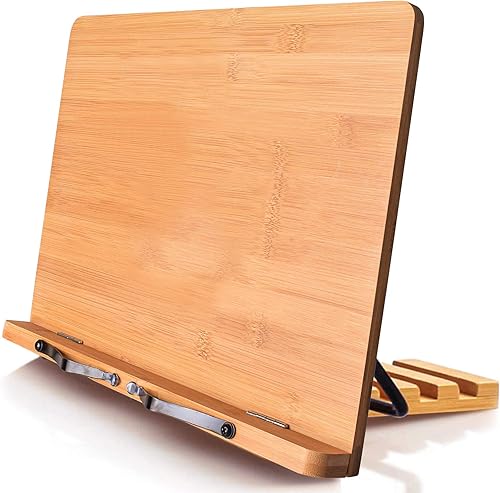
See the current price on Amazon.
View on AmazonCheck the underside of the base for non-slip silicone or rubber feet. Without them, a slick wooden or acrylic bottom can skate backward on wet quartz or granite when you press a stiff book spine flat.
Matching the Stand Style to Your Counter and Cookbooks
Heavy, encyclopedic volumes over 4 pounds (1.8 kg) span 18 to 20 inches (46 to 51 cm) when open. Books that size need a wide-format backboard, a deep front tray, and spring-loaded page clips. A board measuring at least 14 to 15 inches (36 to 38 cm) wide supports both covers so the binding never bends backward over the edges, protecting a glued or sewn spine over years of baking. Rear struts that click into five or six angle positions between 45 and 75 degrees also help reduce neck strain as you move between a prep island and the far side of the kitchen. For a concrete example of these specifications, Norpro Acrylic CookBook / IPad / Tablet Holder shows how those measurements line up with a real counter layout.
Norpro Acrylic CookBook / IPad / Tablet Holder
One more book stand to check against the same criteria.

See the current price on Amazon.
View on AmazonNarrow galley counters with less than 16 inches (41 cm) of usable depth in front of the backsplash leave very little room. An L-shaped or V-shaped acrylic stand saves both visual and physical space, whether it holds printed cookbooks or a 10 to 13 inch (25 to 33 cm) digital tablet. No folding kickstands stick out the back of a single bent acrylic sheet. Total footprint depth often stays between just 5 and 7 inches (13 to 18 cm), though the front lip still needs to curl up at least 1.5 inches (3.8 cm) so a tall book or cased tablet does not tip forward when bumped.

Page holder mechanisms trade off quick page turning against full-page splatter protection.
Frying, searing, or simmering sauces right beside a recipe station puts heirloom cookbooks and handwritten binders at risk. A hybrid base with a full-width transparent splatter guard keeps grease and steam off the paper. Look for a gap between the backrest and the front shield that adjusts or flares from 1.5 inches (3.8 cm) at the bottom to 2.5 inches (6.4 cm) higher up. That flared spacing gives thick volumes breathing room without pinching the spine, a setup represented by Lipper International 8815 Bamboo Wood and Acrylic Cookbook if you compare its listed measurements and layout.
Lipper International 8815 Bamboo Wood and Acrylic Cookbook
Another book stand option to weigh against the points above.

See the current price on Amazon.
View on AmazonReading from tablets as well as paper books calls for a center cutout of 1 to 1.5 inches (2.5 to 3.8 cm) in the bottom lip, which lets a charging cable pass through without propping the device crookedly.
Common Questions
How do I clean oil and dried sauce off an acrylic splatter shield without scratching it?
Skip paper towels, abrasive green scrub sponges, and ammonia window sprays. All three leave tiny hairline scratches or haze on clear acrylic over time. Rinse the shield under warm water first to loosen gritty salt or dried sugar, then wipe gently with a wet microfiber cloth and a drop of mild dish soap before drying with a clean lint-free towel.
What lip depth do I need so a thick 500-page cookbook stays open on the first and last chapters?
Aim for an internal front ledge depth of 1.75 to 2.25 inches (4.4 to 5.7 cm) for 400-to-600-page hardcovers. Opening a thick book near the front or back cover pushes a tall stack of pages forward much farther than in the middle chapters, so pairing a 2 inch (5.1 cm) tray depth with flexible spring clips or a hinged front shield stops the heavy side from popping over the rim.
Research-based. Based on manufacturer specifications and public information. Product details can change after the last-updated date. Prices are not shown here; check the retailer for the current price.