- A basic power strip only adds outlets and has no surge-diverting components.
- Look for UL 1449 certification, at least 1,000 to 2,000 joules, and a 330 V or 400 V clamping rating.
- Check the Protected indicator light regularly, since surge components wear down over time.
Why a Multi-Outlet Power Strip Is Not Automatically a Surge Protector
Plug a desktop computer, two monitors, and a router into a plastic bar under your desk, and you might assume the gear is safe from voltage spikes. Often, it is not. In many homes and offices, that bar is just a multi-outlet power strip acting as an extension cord with extra sockets. Both devices look nearly identical from across the room at the end of a 6-foot (1.8 m) heavy-duty cord, yet only a true surge protector holds internal parts that absorb or divert sudden voltage spikes before they hit sensitive circuit boards.
Flip the housing over. You can tell the two apart in thirty seconds by reading the rear stamp or sticker and checking the top indicator lights. A basic unit lists only standard electrical ratings, which are typically 125 volts (V), 15 amps (A), and 1,875 watts (W) in North America, alongside a UL 1363 mark for relocatable power taps. A true surge suppressor adds three distinct details: a UL 1449 certification mark, a joule energy absorption rating, and a clamping voltage or Voltage Protection Rating (VPR). It also includes at least one LED labeled Protected or Surge.
Belkin 12-Outlet Surge Protector Power Strip (BE112230-08)
A power strip worth comparing against the criteria in this guide.

See the current price on Amazon.
View on AmazonKnowing what those numbers mean prevents two common mistakes: plugging expensive electronics into a bare tap, or overspending on heavy-duty suppression for a bedside reading lamp. Large appliances like air conditioners and refrigerators cycle on and off all day. Utility grid switching happens down the street as well, sending brief voltage transients along household wiring. Standard North American wall outlets supply roughly 120 V of alternating current, and when a spike pushes that line past normal levels, a basic strip passes the entire wave straight into your equipment's power supply. A surge protector blocks that surge by routing the excess energy into the building's grounding wire while normal current flows without interruption.
A resettable 15 A rocker switch on the end of a housing only trips during sustained current overloads, such as plugging a space heater and a toaster into the same bar. It does nothing to stop a fast, high-voltage spike.

A surge protector adds a voltage-diverting path to ground that a basic strip lacks.
Comparing a Basic Power Strip and a Surge Protector by the Numbers
Inside the casing, a small semiconductor part called a metal oxide varistor (MOV) does the actual work. At normal line voltage around 120 V, the MOV acts as an open gate and does nothing. Once voltage climbs past a preset limit, the MOV drops its resistance within a few nanoseconds and shunts the extra electrical energy into the ground line. Basic outlet strips leave out MOVs completely, so their rear labels never mention energy absorption or clamping levels. For a concrete example of how manufacturers print these numbers on housing labels, Tripp Lite Protect It! 12-Outlet Surge Protector (TLP1208SAT) shows these standard markings clearly.
Tripp Lite Protect It! 12-Outlet Surge Protector (TLP1208SAT)
One more power strip to check against the same criteria.
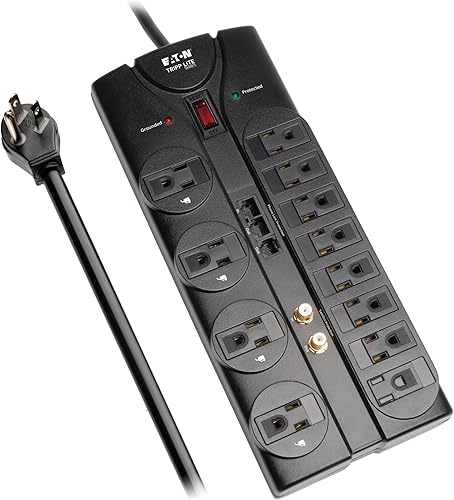
See the current price on Amazon.
View on AmazonFour technical figures on the label separate an ordinary cord splitter from a dedicated suppressor. The table below outlines how the two categories differ, using examples of typical ranges found on residential and office models.
| Specification | Basic Power Strip | Entry-Level Surge Protector | Heavy-Duty Surge Protector |
|---|---|---|---|
| Safety Standard | UL 1363 | UL 1449 (often paired with UL 1363) | UL 1449 (often paired with UL 1363) |
| Joule Rating | None (0 J) | 400 J to 900 J | 1,000 J to 3,000+ J |
| Clamping Voltage (UL 1449 VPR) | Not applicable | 400 V to 500 V | 330 V to 400 V |
| Response Time | Not applicable | Under 1 nanosecond (ns) | Under 1 nanosecond (ns) |
| Status Indicators | Power switch illumination only | Single Protected LED | Protected and Grounded LEDs |
Joule Capacity: The Fuel Tank of Surge Suppression
One joule equals one watt of power applied for one second. On a suppressor label, the joule figure shows how much total energy the internal MOVs can soak up before they wear out and stop working. Think of it as a non-refillable tank. A single 1,500-joule spike can drain a 1,500-joule unit at once, or dozens of smaller 50-joule transients from household motors can gradually empty it over time. When that capacity runs out, the MOVs are done.
Tripp Lite Protect It! 6-Outlet Surge Protector (TLP606)
Another power strip option to weigh against the points above.

See the current price on Amazon.
View on Amazon
Higher joule capacity extends the working life of the internal surge components.
Clamping Voltage and UL 1449 Voltage Protection Rating (VPR)
Joules measure endurance. Clamping voltage measures sensitivity. It sets the exact voltage threshold that forces the MOV to open the path to ground, which tells you the maximum let-through voltage reaching connected gear during a standardized test spike. Under the UL 1449 standard, Underwriters Laboratories tests suppressors with a 6,000 V, 3,000 A combination wave and assigns a fixed Voltage Protection Rating from a set tier list. For 120 V household lines, those three tiers are 330 V, 400 V, and 500 V.
Lower clamping numbers mean tighter protection. Unlike joule ratings, a smaller voltage figure shows that the suppressor reacts earlier and lets less excess energy slip past to your electronics. Computers, televisions, and audio interfaces generally call for a 330 V or 400 V VPR, whereas a 500 V unit allows higher voltage through before clamping down. Three label details help you read the fine print:
- Look for VPR rather than older SVR labels: Older suppressors listed a Suppressed Voltage Rating (SVR) based on a smaller 500 A test current. Modern UL 1449 Third and Fourth Edition labels list VPR tested at 3,000 A to reflect real-world electrical disturbances.
- Check which wiring modes are covered: A wall receptacle holds three wires: Hot (line), Neutral, and Ground. Basic surge units only place MOVs between Line and Neutral (L-N). Full 3-line protection places MOVs across all three paths: Line to Neutral (L-N), Line to Ground (L-G), and Neutral to Ground (N-G).
- Verify indicator light behavior: A Protected light confirms the MOV circuit is intact, while a separate Grounded or Wiring OK light confirms the wall outlet has a working ground path. Without a grounded three-prong outlet, an MOV has nowhere to divert energy.
If the Protected LED on your strip goes dark or turns red while the outlets still supply power, the internal surge components are spent. At that point, the device is operating as a plain outlet strip and should be replaced if your gear still needs surge defense.
Compact multi-outlet strips vary widely on these three specs, and Belkin 6-Outlet Surge Protector Power Strip (BE106000-06) illustrates how manufacturers list VPR and wiring modes on a smaller housing.
Belkin 6-Outlet Surge Protector Power Strip (BE106000-06)
A power strip worth comparing against the criteria in this guide.

See the current price on Amazon.
View on AmazonWhich Type Fits Your Setup
A home office desk holding a laptop dock, an external monitor, a desktop PC, or a network-attached storage drive calls for a surge protector with a UL 1449 VPR of 330 V or 400 V and at least 1,000 to 2,000 joules. Delicate low-voltage DC power supplies and microprocessors sit inside all of these machines. Repeated transient spikes over months of daily use slowly wear those components down. Models that include both a Protected light and a Grounded light also confirm at a glance that the wall receptacle is wired properly and the internal MOVs remain active.
Simple resistive or mechanical loads need much less. Table lamps, a box fan, a basic drip coffee maker without a digital clock, or holiday string lights work fine on a basic UL 1363 power strip with a 15 A circuit breaker. Because these appliances lack fragile circuit boards that suffer from microsecond voltage fluctuations, high joule capacity adds no real value here. Workshop tools and garage chargers that draw steady, heavy current also pair well with a rugged metal outlet strip built around a 15 A overload breaker.
Equipment plugged into an Uninterruptible Power Supply (UPS) battery backup or a whole-room power conditioner also calls for a basic non-surge power strip when you need extra outlets downstream. UPS manufacturers warn against plugging a secondary MOV surge suppressor into battery-backed outlets. Two competing protection circuits can interfere with load sensing and battery switching. Whether you are expanding outlets behind a UPS or comparing standalone hardware for general room electronics, Anker 351 Power Strip Surge Protector (A9128) offers another layout with detailed electrical ratings to compare.
Anker 351 Power Strip Surge Protector (A9128)
One more power strip to check against the same criteria.

See the current price on Amazon.
View on AmazonCommon Questions
Can a surge protector still power my devices after its joules are used up?
Yes. In many standard designs, the AC outlets keep passing electricity even after the internal MOVs sacrifice themselves to absorb a spike. That creates a false sense of security because your television or computer stays on while the bar has silently turned into a plain outlet expander. Some units include an automatic shutoff feature, often called fail-safe mode, which permanently cuts power to the outlets once the MOV thermal fuse opens so you know the protection circuit is spent.
Does plugging one surge protector into another double the joule rating?
No. Daisy-chaining two units neither combines their joule capacities nor lowers the clamping voltage, and it violates both UL safety guidelines and standard electrical codes. Plugging one multi-outlet bar into another risks overloading the primary cord past its 15 A, 1,875 W limit while disrupting how the internal MOVs and circuit breakers time their response. Skip the two chained 6-outlet bars and pick a single 10-outlet or 12-outlet unit with a 6-foot (1.8 m) or 8-foot (2.4 m) cord that reaches the wall outlet directly.
Before buying a wide 12-outlet unit, check whether your wall plugs are large AC adapters. Widely spaced transformer outlets, often separated by about 1.5 inches (3.8 cm) to 2 inches (5.1 cm), keep bulky bricks from blocking neighboring sockets.
Research-based. Based on manufacturer specifications and public information. Product details can change after the last-updated date. Prices are not shown here; check the retailer for the current price.